
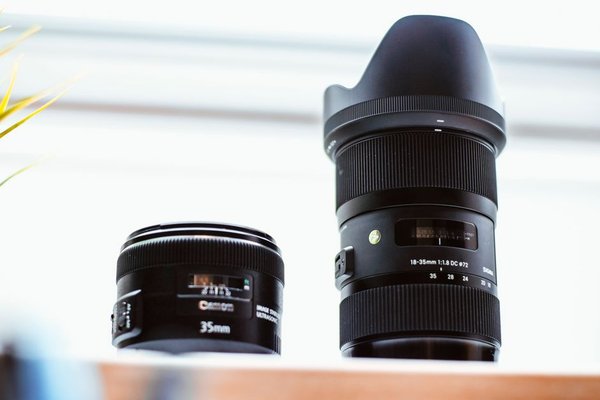
The prime vs zoom lens decision comes down to what happens between spotting a photograph and pressing the shutter. A prime can make a camera easier to carry and work beautifully in dim light. A zoom can save the shot when your subject moves and you cannot follow. Neither design wins every comparison, so the useful question is which compromises suit your photography.
The core difference: fixed versus variable focal length
A prime is a fixed focal length lens. A 35mm prime stays at 35mm, so changing the framing means repositioning yourself, cropping later or changing lenses. A zoom has a variable focal length, such as 24–70mm or 70–200mm, allowing you to change the angle of view by turning a ring.
Shorter focal lengths show more of the scene; longer ones narrow the view and make distant subjects fill more of the frame. These numbers describe optical properties, not the physical length of the lens. Sensor size also affects framing, so compare lenses on the same camera format. Our guide to camera sensor sizes explains that relationship.
Both designs can be wide-angle, standard or telephoto. The defining difference is whether their focal length changes.
Size and weight: look beyond a single lens
One of the most appealing prime lens benefits is portability. A modest 35mm or 50mm f/1.8 prime may be compact enough to keep mounted all day. Professional zooms often require larger, heavier optical assemblies to cover a range of focal lengths.
However, a single 24–105mm zoom can replace several separate primes for a travelling photographer. Three primes plus accessories may weigh more than one zoom. Some specialist or large-aperture primes are substantial too. Compare actual dimensions and the full kit you intend to carry, not just lens labels.
Aperture and speed in low light
Lens “speed” refers mainly to maximum aperture, not how quickly autofocus locks on. A lens rated f/1.8 opens wider than one rated f/2.8, admitting more light at the same shutter speed. That can help you photograph a moving person indoors without pushing ISO as high. Wide apertures also make shallow depth of field easier to achieve.
Affordable primes frequently offer f/1.8, whereas many standard zooms top out at f/2.8 or f/4. Still, some primes have modest apertures, and professional fast zooms exist. Always compare the numbers on the specific lenses.
Constant versus variable maximum aperture
A 24–70mm f/2.8 zoom can maintain its maximum f/2.8 opening throughout the range. A 24–105mm f/4–7.1 zoom offers a narrower maximum opening toward the telephoto end. All zooms vary focal length; only some vary maximum aperture as they zoom. This matters in dim environments but less for landscapes photographed on a tripod at f/8.
Image quality: does a prime always look better?
Primes can be easier to optimize optically because designers work with one focal length. At comparable prices, they may offer better edge sharpness or fewer optical compromises. But modern quality zooms can produce extremely sharp images, and differences often become less important than focus accuracy, light and technique.
Evaluate individual models rather than assuming a category wins. Look at sharpness across the frame, distortion, chromatic aberration, flare resistance and performance at your preferred aperture. Lens correction software helps with certain defects but does not erase every difference.
Background blur is another reason photographers like primes. Yet blur depends on aperture, focal length, subject distance and the background, not the word “prime.” A longer zoom setting can also isolate a subject effectively.
Flexibility can matter more than specifications
The zoom lens benefits become obvious when movement is restricted. Imagine photographing a school performance from an assigned seat. With a 24–70mm zoom, you can photograph the entire stage and then frame one performer without interrupting the moment. With a 35mm prime, you may have to accept a wider composition and crop later.
Now imagine a café portrait in soft evening light. A 50mm f/1.8 prime might allow a faster shutter speed and a pleasingly soft background. When your shooting position is predictable, its simplicity becomes an advantage.
There is an important catch to the phrase “zoom with your feet.” Moving closer changes perspective: nearby facial features become relatively larger compared with distant ones. Zooming from the same camera position changes framing without changing that perspective. Stepping closer is therefore not a perfect substitute for a zoom.
Price and practical value
An entry-level 50mm prime can be an inexpensive route to a wide aperture. A premium f/2.8 zoom can cost much more, although collecting several high-end primes may cost more still. Budget zooms and expensive specialist primes make universal price comparisons misleading.
Check camera-mount compatibility, autofocus, weather sealing and stabilization before purchasing. Stabilization helps reduce camera shake; it does not freeze an actively moving subject. Our camera lens buying guide covers additional selection factors.
Which lens should you choose?
A prime makes sense if
You often shoot portraits, street scenes or low-light subjects from predictable distances, want a wide aperture or prefer a compact everyday setup. Working within a fixed view may also encourage careful composition.
A zoom makes sense if
You cover events, travel, wildlife or unpredictable action, need several compositions quickly or want to avoid frequent lens changes. A standard zoom also helps newcomers discover which focal lengths they enjoy.
Try this before buying another lens: photograph an ordinary weekend with your zoom, then examine the focal lengths saved in your pictures. If most successful frames cluster around 35mm and you want better low-light capability, consider a 35mm prime. If you regularly use the entire range, your zoom is already doing valuable work. Our photography composition basics guide offers ways to improve either setup.
Frequently asked questions
Are prime lenses sharper than zoom lenses?
They sometimes are at similar price points, but not automatically. Model design, aperture, focal length and shooting conditions determine the result.
Is a zoom lens better for beginners?
Often, because it introduces several focal lengths without requiring lens changes. A prime can be equally useful for someone with a clear subject preference.
Can you zoom with your feet using a prime?
You can move to reframe, but moving changes perspective and may be impossible or unsafe. The result is not identical to zooming from one position.
Do professionals use primes or zooms?
Both. Fast primes suit many portraits and low-light assignments; zooms suit situations where framing must change quickly.
Final verdict
Choose a prime when you value a particular focal length, potential size savings and often a wider maximum aperture. Choose a zoom when changing your framing quickly matters more. The best choice is the lens that removes the obstacle between you and the photographs you want to make.